The Erzgebirge (ore mountains) made Saxony a rich country. Most of the richness went to Dresden, Germany – but a little bit of it remained nearby at Chemnitz. This includes some fantastic ancient buildings but also some collections of art. The Kunstsammlungen Chemnitz (art collections) can be found in the main building at the Theaterplatz in the center of the city. Additionally three other museums belong to it: the museum for modern art (Museum Gunzenhauser), the Schloßbergmuseum and the Henry van de Velde museum.
Continue reading “Kunstsammlungen”Industriemuseum
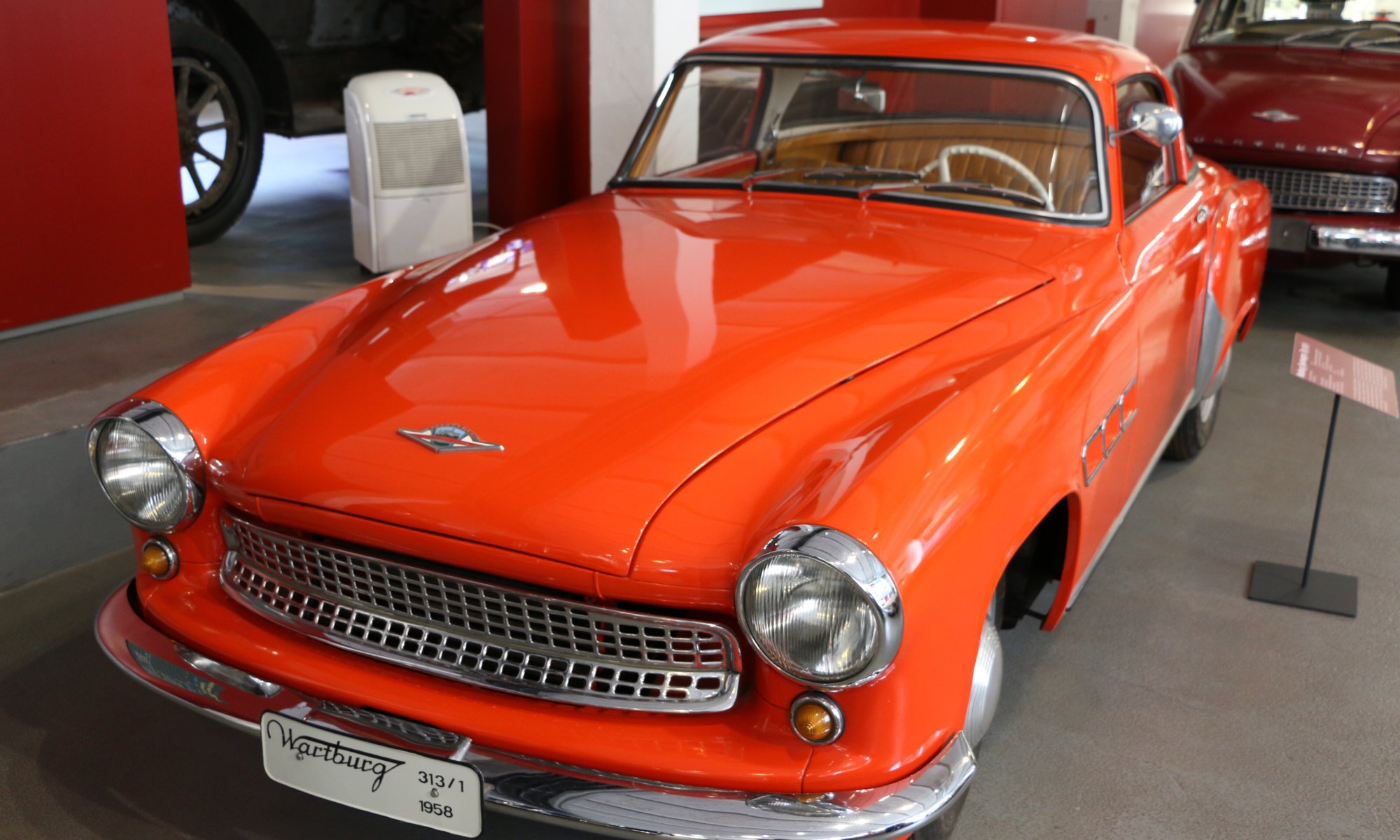
The city of Chemnitz, Germany has a long industrial history: In the 18th century the production of textiles became important and due to the usage of hydropower the spinning works became efficient. During the 19th century machine construction was in focus (including steam engines and steam railway engines). Chemnitz was one of the most important industrial cities in Germany by that time and sometimes named the ‘Manchester of Saxony‘. And the 20th century was the time of car manufacturing – included all the neighboring industries ja need to build a complex car.
Continue reading “Industriemuseum”Roter Turm
You wouldn’t guess it while visiting Chemnitz, Germany, but the Roter Turm (red tower) is considered the town’s landmark. It is a tower standing close to the city center which was built as a bergfried in the 12th century. Later it was included into the city fortifications and used as a prison. August Bebel (one of the founders of the Social Democratic Party in Germany) was one of the well-known ‘guests’ there, but that’s not the reason for the name: the material used to build it (tuff) has a red colour by nature. The fame of this building roots in the fact that it is older than Chemnitz and older than the city of Dresden.
Continue reading “Roter Turm”Kalle
Karl Marx never went to Chemnitz, Germany. But nevertheless the city was named Karl-Marx-Stadt between 1953 and 1990 to honour him. That is also the reason why you can find a massive, 7 meters high representation of his head close to the city center. It weighs 40 tons and was created by Soviet sculptor Lew Kerbel. In the background attached to a building you can read the words ‘Working men of all countries, unite!‘ from the communist manifesto (written by Marx and Engels) in four languages. Locals call the memorial ‘do Nischel‘ – ‘Nischel‘ just means ‘head‘ in the middle high German language.
Continue reading “Kalle”Museo del Ferrocarril
The Estación de Delicias was once an important railway station of Madrid, Spain. It was closed in 1969 and has now a second life as a railway museum (Museo del Ferrocarril). The wonderful building from 1879 is now filled with different locomotives, steam engines and railway cars. Most interesting item is the Talgo II train used between 1950 and 1972 – you can even enter it and look inside.
Continue reading “Museo del Ferrocarril”Mercado de San Miguel
If you’re in need of some tapas or a good glass of wine the Mercado de San Miguel at Madrid, Spain might be your favorite place. But you shouldn’t be afraid of masses of people in an ancient market hall. The building dates back to 1916 and already the design makes it worth to visit the place. Most people for sure come for the more than 30 vendors from which you can get small snacks of every kind and different drinks.
Continue reading “Mercado de San Miguel”Templo de Debod
Not far away from the Plaza España at Madrid, Spain you can find something quite suprising: an ancient Egyptian temple, the temple of Debod. How did that happen? When the Aswan dam was built in 1960 different archeological sites were threatened. The UNESCO then asked all countries around the world for help and as Spain helped to preserve the temple of Abu Simbel they received the small temple of Debod as a gift.
Continue reading “Templo de Debod”Valle de los Caídos
It is a place that makes me angry. I mean really angry. A beautiful place with impressive architecture. A symbol of the Spanish civil war. A place where you can see the differences in remembrance culture. A place that creates a lot of discussions still today. It is a place where I would immediatly leave the catholic church if I would by a member. And somehow this all makes it worth to visit the Monumento Nacional de Santa Cruz del Valle de los Caídos at San Lorenzo de El Escorial near Madrid, Spain.
Continue reading “Valle de los Caídos”El Escorial
A giant palace with wonderful architecture and a large garden, a cloister, a UNESCO world heritage site, the largest building in renaissance style and the graveyard for most kings and queens of Spain – that is what the Real Sitio de San Lorenzo de El Escorial at San Lorenzo de El Escorial near Madrid, Spain is. And why can it be found at the Sierra de Guadarrama, 46 kilometers outside of the capital city? Because Philip II won a battle against the French in 1557 on the day of San Lorenzo. He wanted to build a cloister for this saint and his star-mongers selected this place.
Continue reading “El Escorial”Cathedral de la Almudena
The Cathedral de Santa María de la Almudena is quite a surprising roman-catholic church at Madrid, Spain: plans for this church exist since the 16th century, construction works started in the 19th century – but it was only finished in 1993. Therefore this church looks very modern inside and the style of the church was adopted over time to fit to the surrounding buildings (that for sure changed since the 16th century).
Continue reading “Cathedral de la Almudena”