The Diana, Princess of Wales Memorial Playground is one of London’s most memorable places for families, tucked into the north-west corner of Kensington Gardens. It opened in 2000 as a tribute to Princess Diana, who lived at nearby Kensington Palace, and was built on the site of an earlier Peter Pan playground associated with J. M. Barrie. Its purpose is simple but fitting: a free, imaginative space where children can play, explore and enjoy the gardens that were so closely linked with the princess.
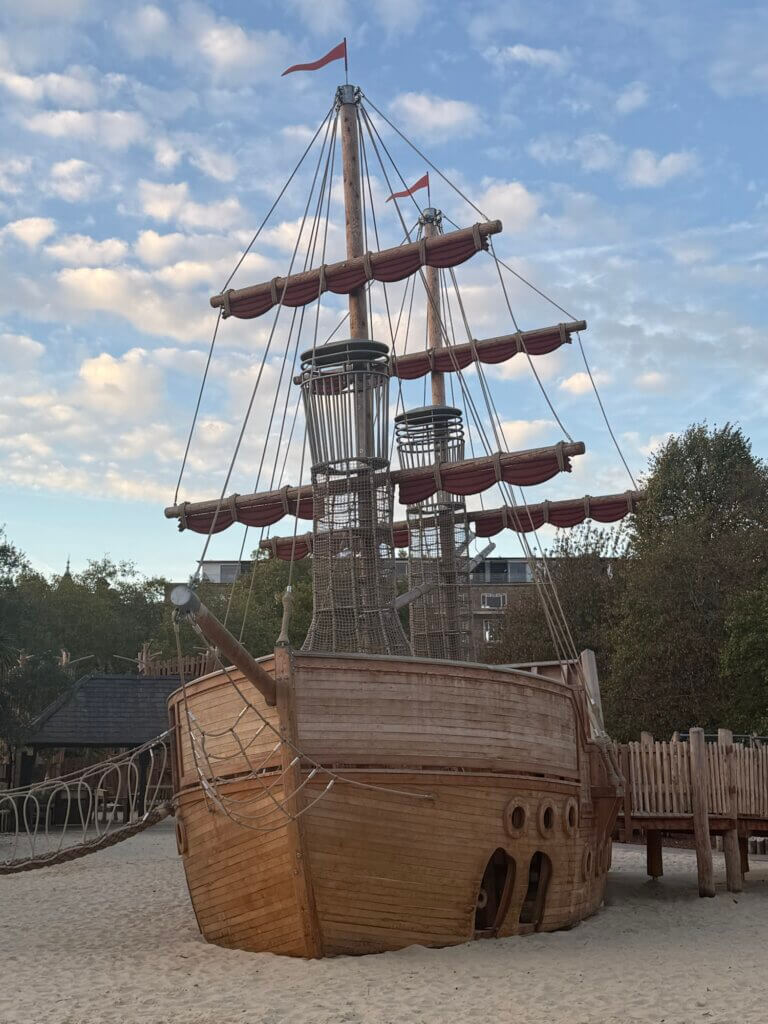
The playground’s theme draws directly on Peter Pan in Kensington Gardens and the wider world of Neverland. Its centrepiece is a large wooden galleon, now a renewed 17-metre by 12-metre ship set on a sandy ‘beach’, which children can climb, explore and turn into whatever adventure their imaginations demand. Around it are a treehouse with towers and a tunnel slide, sand and water play, timber houses for younger children, sensory features and plenty of natural planting, all designed to encourage creative, social and physical play.
In appearance, it feels less like a conventional playground and more like a miniature, slightly wild corner of a storybook. The timber ship dominates the sandy area, while paths wind between climbing structures, greenery and play zones; the recent refurbishment has also made the space more inclusive, with wheelchair-accessible areas in the galleon and treehouse, improved paths and raised sand and water-play tables. It is a place where the design deliberately invites children to invent their own games rather than simply queue for fixed equipment.
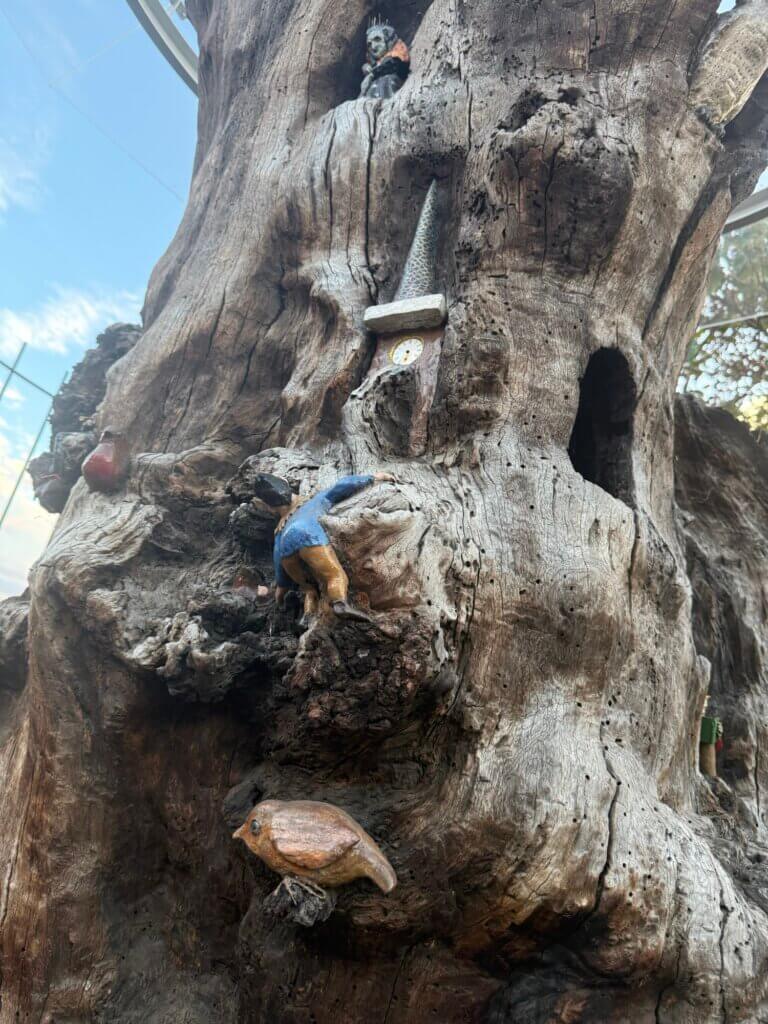
Access is carefully controlled for safety: adults may enter only when supervising children aged up to 12, and children must be accompanied by an adult when entering or leaving. Just beside the playground stands another enchanting Kensington Gardens landmark, the Elfin Oak: an ancient oak stump carved by illustrator Ivor Innes in 1928 with tiny elves, gnomes and woodland creatures, now protected behind a cage but still a delightful companion to the playground’s fairy-tale atmosphere.
Princess Diana
Diana, Princess of Wales, was born Diana Frances Spencer on July 1st, 1961 and became one of the most recognisable women in the world after her marriage to Charles, Prince of Wales, in 1981. As the mother of Prince William and Prince Harry, she brought a more personal, accessible presence to the British royal family. Yet her marriage was troubled, and after the couple separated and divorced in 1996, she retained her title and continued to shape public life on her own terms.
What made Diana special was not simply her glamour, though her style and charisma were undeniable. It was the way she used her extraordinary visibility to draw attention to people often pushed to the margins. She supported causes ranging from homelessness and children’s welfare to leprosy and HIV/AIDS, and her willingness to touch and embrace patients challenged widespread fear and stigma. In 1987, she opened the UK’s first purpose-built HIV/AIDS unit at London’s Middlesex Hospital and was photographed shaking hands with patients without gloves – a simple gesture with enormous symbolic force.
Her later campaign against anti-personnel landmines showed the same instinct to act where others hesitated. In 1997, she walked through a minefield in Angola wearing protective equipment, helping to bring global attention to the civilian suffering caused by these weapons. Diana died on August 31st, 1997, aged 36, in a car crash in Paris, and the public mourning that followed reflected how deeply she had connected with people. She is still remembered as the ‘People’s Princess’: a figure whose compassion, vulnerability and refusal to remain distant made royalty feel more human.
Diana Princess of Wales Memorial Playground
London
England
United Kingdom
Loading map...
