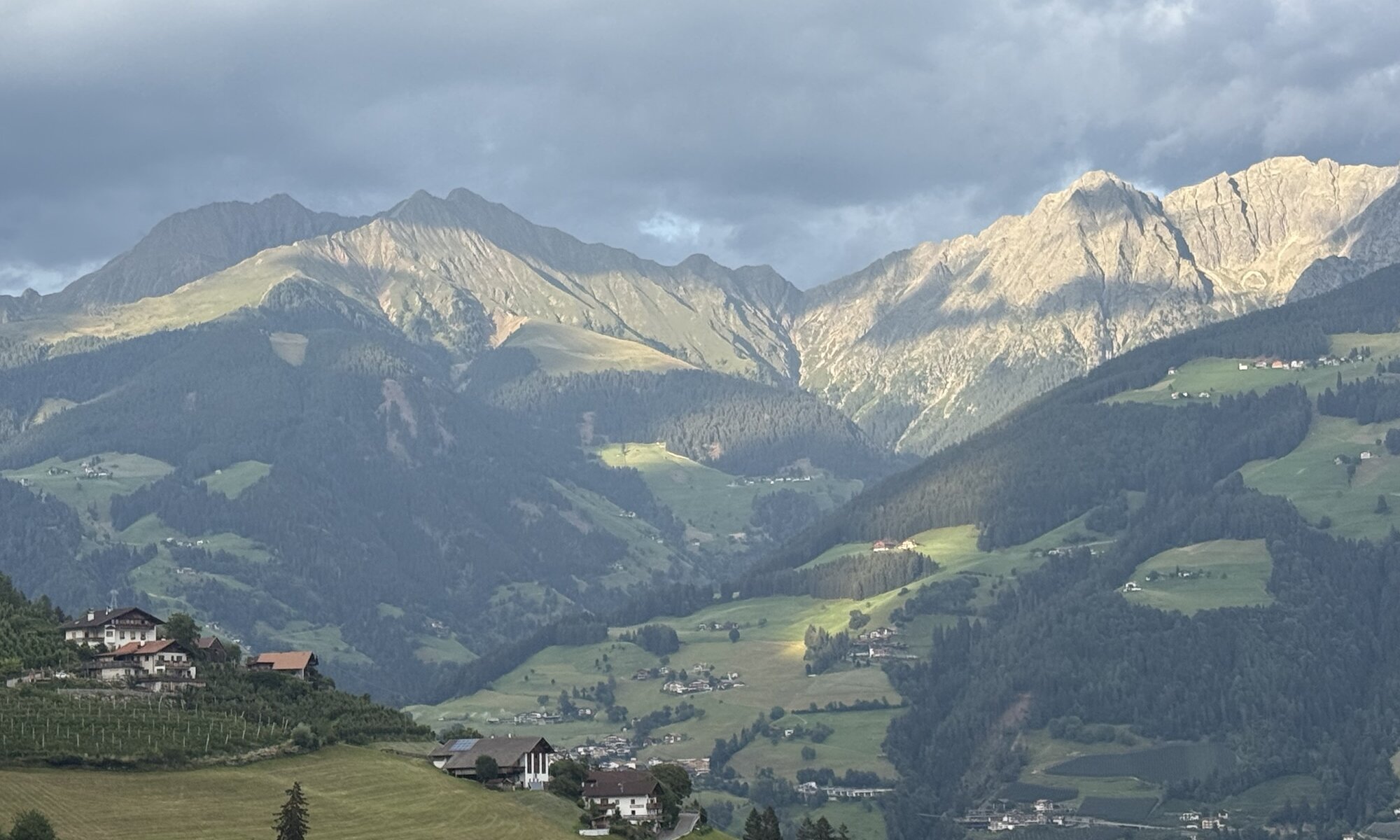
Alto Adige, or South Tyrol, is a fascinating region where languages and cultures overlap in a way that feels both Alpine and distinctly Mediterranean. Three languages are officially recognised: German, Italian, and Ladin. German is by far the most widely spoken in everyday life, especially in towns and rural areas, while Italian tends to dominate in the larger cities such as Bolzano. Ladin, a Rhaeto-Romance language, survives in a few Dolomite valleys and adds another layer to the region’s cultural richness.
As a child, my parents returned year after year to the same holiday home (Haus Windisch) in Dorf Tirol in South Tyrol. It became something of a family tradition, with familiar landscapes, walking routes, and local faces shaping my early impressions of the Alps. There was a reassuring sense of continuity in going back to the same place, watching the seasons shift slightly from one visit to the next, yet always recognising the surroundings.
This arrangement was particularly convenient for my parents. The journey by car via the Brenner Pass was straightforward and reliable, making it an accessible destination from Germany. More importantly, German is widely spoken throughout South Tyrol, which made communication effortless for them. As they do not speak any foreign languages, the ability to converse naturally in German removed any barriers and allowed them to feel completely at ease.
The reason German is spoken in South Tyrol lies in its history. The region was part of the Austro-Hungarian Empire until the end of the First World War, after which it was annexed by Italy. Despite periods of enforced Italianisation, especially under Fascist rule, the German-speaking population maintained its language and cultural identity. Today, South Tyrol enjoys a high degree of autonomy, and both German and Italian are used in administration, education, and daily life, preserving the region’s unique bilingual character.
Ladin
Ladin is a Romance language spoken in a few scattered valleys in the Dolomites, mainly in parts of South Tyrol, Trentino and Belluno. It is closely related to Romansh in Switzerland and Friulian in north-eastern Italy, and it developed from the Latin brought into the Alps after Roman rule reached the area.
It exists because these mountain communities were relatively isolated for centuries, which allowed their local Latin-based speech to survive and develop separately from surrounding Italian and German influences. That isolation preserved a distinct linguistic identity rather than letting the language disappear into the larger regional tongues.
- Bun dé – Hello.
- Buna sëra – Good evening.
- Prëitambel – Please.
- Giulan – Thank you.
In Alto Adige today, Ladin plays an important cultural and civic role. It is a marker of identity for Ladin communities, is recognised in public life, and has a place in education, administration and local signage in the areas where it is spoken. Beyond practical use, it also represents continuity, reminding visitors and residents alike that the Dolomites are not only a landscape of mountains, but also of living minority cultures.
Alto Adige / South Tyrol / Südtirol
Italy
Loading map...
