
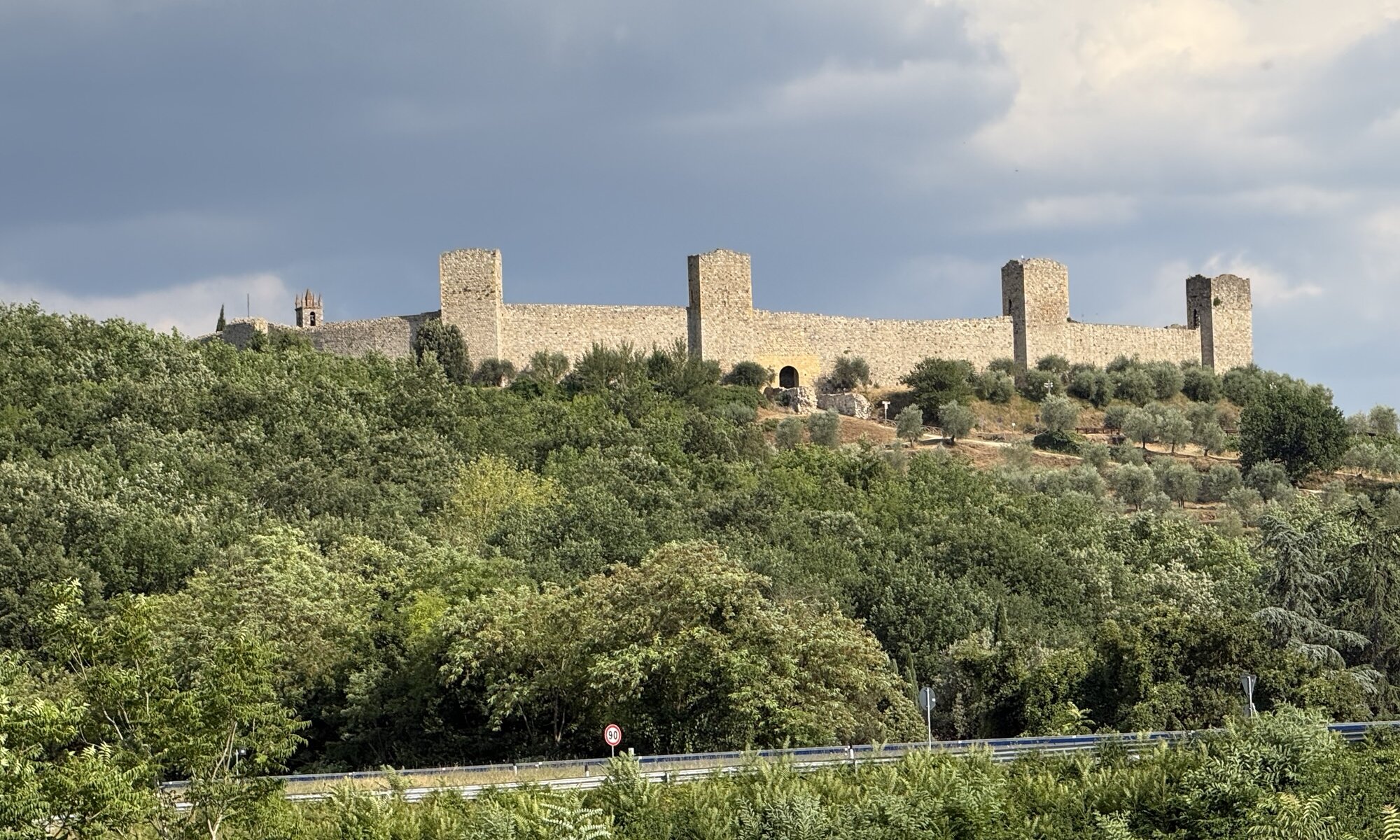
The Castello of Monteriggioni rises like a perfect medieval model on a low Tuscan hill, a compact ring of stone battlements and towers that seems almost designed to be admired from a distance. Built by the Republic of Siena in the early 13th century as a forward defensive outpost, its compact, circular curtain wall and regularly spaced towers created a stronghold that could watch the approaches toward both Siena and Firenze and control the nearby stretch of the Via Francigena. The castle’s origin as a purpose-built military settlement explains its unusually cohesive plan: rather than growing organically, the walls, gates and internal square were laid out with clear strategic intent, which gives Monteriggioni its rare sense of architectural unity.
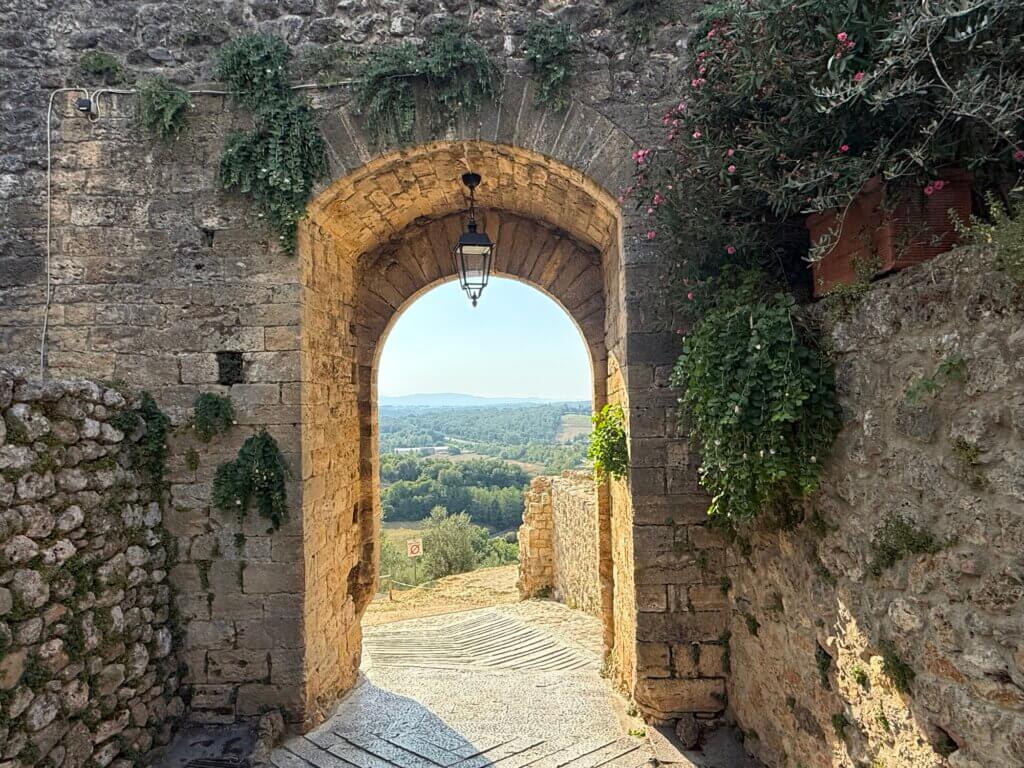
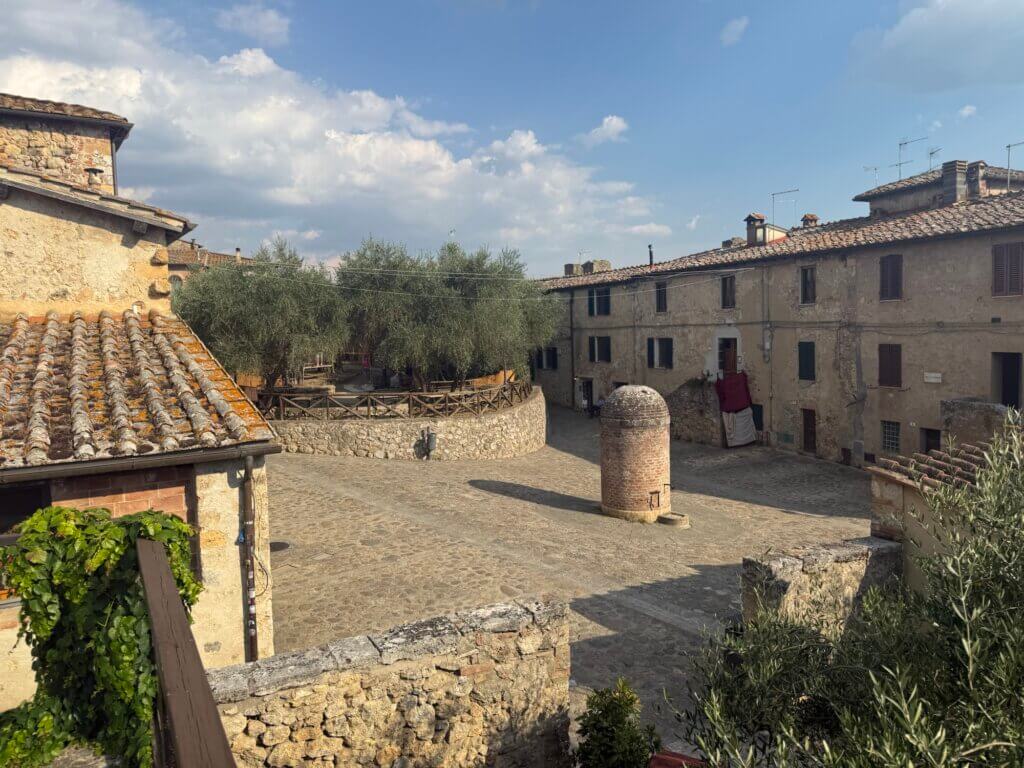
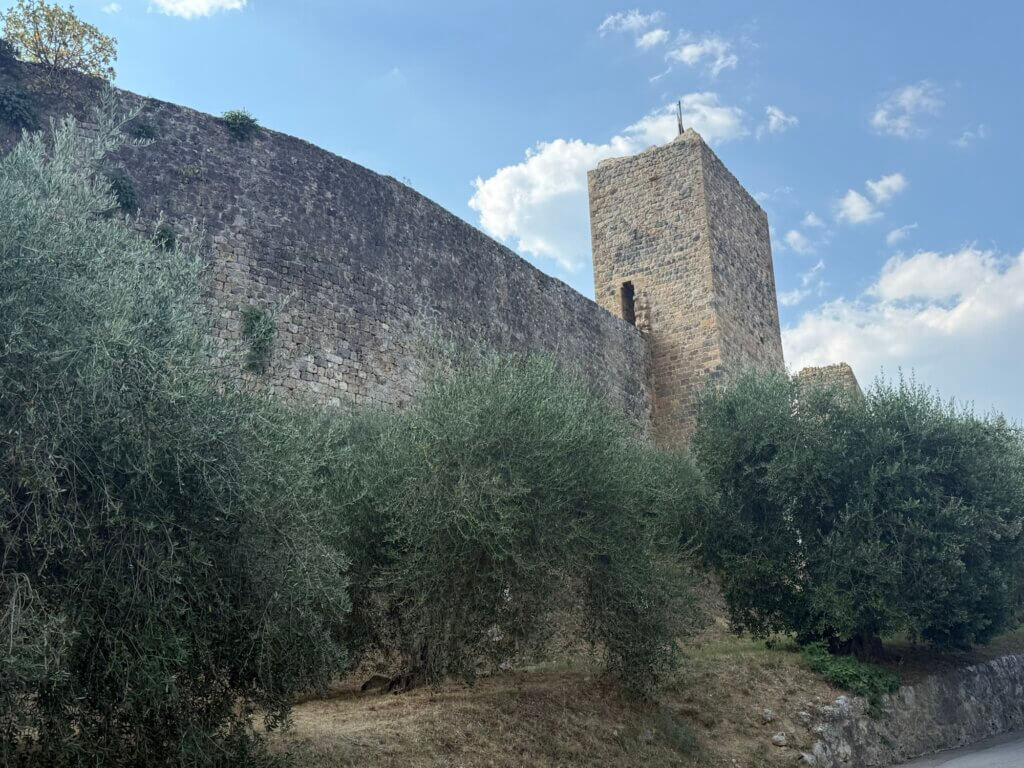
What makes Monteriggioni special is that its medieval silhouette has survived with extraordinary clarity, so visitors can still read the original military logic in the masonry and towers. The defensive ring – originally equipped with about fifteen towers of which most remain visible – sits directly on the crest of the hill, and the walk along the crenellated ramparts offers those same sightlines that would have mattered to soldiers centuries ago. Its literary fame also contributes to the aura: poets and chroniclers over the ages have noted the ‚circle of towers‘, and that atmosphere of time-stopped Tuscany makes the place feel like a lived museum rather than a restored set.
Inside the walls the castle opens onto a compact medieval village centred on a plain piazza and a small parish church, so the experience alternates between military engineering and everyday medieval life. Today you can climb sections of the battlement walk and enter through the historic gates to see the central square, the Pieve of Santa Maria Assunta with its simple Romanesque and Gothic details, and small civic buildings that preserve the scale and texture of a fortified communal settlement. There is also a modest museum of arms and local history that helps explain how the fortification functioned during sieges and border skirmishes between Siena and Firenze.
For a visitor the pleasures are both visual and practical: a stroll on the ramparts gives sweeping views over the Chianti and the Val d’Elsa, making it a superb spot for photography or a quiet pause with a bottle of local wine. The village’s cobbled streets host a handful of artisan shops, cafés and seasonal events that animate the square without overwhelming the historic fabric, so you can move easily from studying stonework to sampling Tuscan food. In short, Monteriggioni rewards anyone interested in military architecture, medieval urban planning or simply the feeling of stepping into a recognisably medieval Tuscan scene that has kept its character across eight centuries.
Monteriggioni
Tuscany
Italy
Loading map...
